
Treat a pawn capture as a route change. Check the file you enter, the route you leave open, and the opponent’s immediate response before judging the capture.
Forward movement and captures solve different problems
Pawns normally advance forward and capture diagonally. That distinction gives a compact pawn board two overlapping maps: the squares a pawn can move into and the squares it can attack. An empty diagonal square is not a normal capture destination, and an occupied square straight ahead blocks a normal advance.
When studying Pawn Chess, read both maps. Your fastest route might require a diagonal capture to leave a blocked file. Another pawn may be valuable because it controls a diagonal entry square, even if it is not the runner you expect to finish with.
Compare the old file with the new file
Before capturing, trace the pawn’s next two moves from its destination. Does it now have space to advance? Can an opposing pawn capture it immediately? Does its new diagonal attack create a useful threat? This simple preview prevents a capture from becoming an accidental detour.
Then inspect what the move changes behind it. A pawn that leaves a file may stop blocking an opponent. If that opponent can now advance freely, compare its finish time with yours. In a race, opening the wrong route can matter more than the material you just removed.
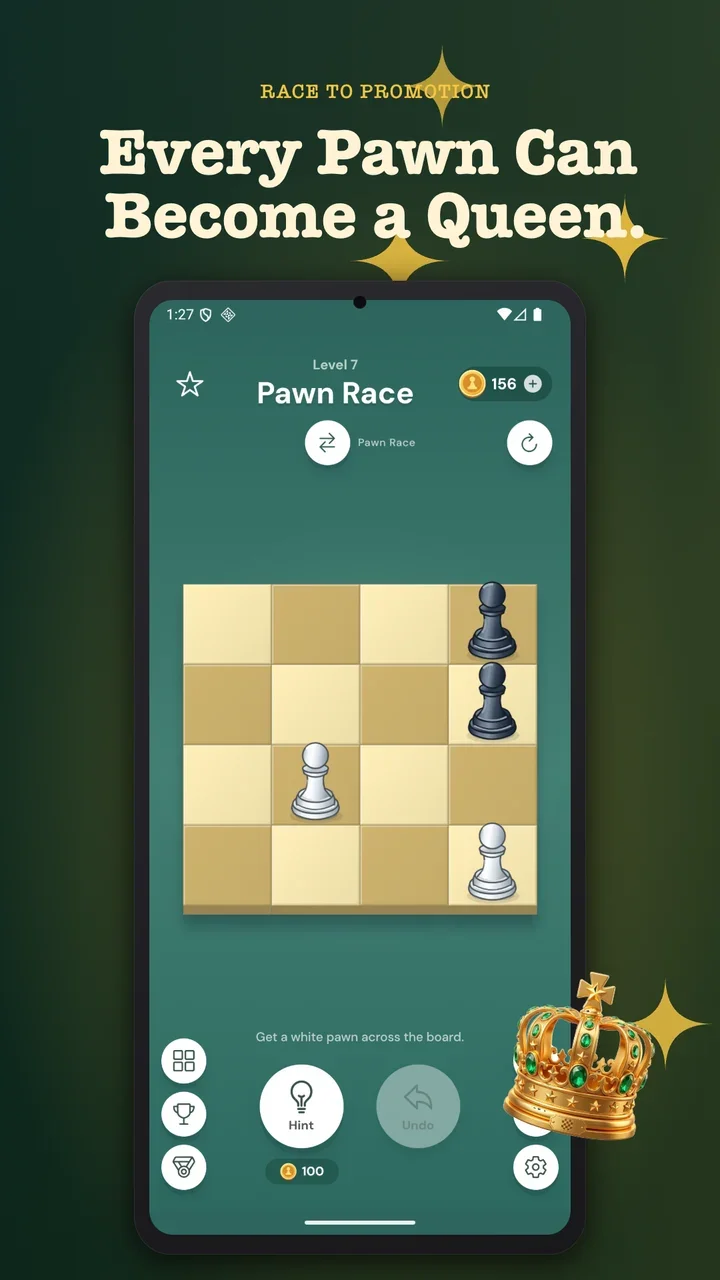 IN-GAME VIEW
Compare your route with the opposing pawns. The destination of a capture matters as much as the piece you remove.
Gameplay reference, not a solution to a specific level.Understand the en passant window
Under standard chess rules, en passant is available immediately after an opposing pawn makes an eligible two-square advance past a pawn in the appropriate adjacent position. The capturing pawn moves diagonally to the square the opponent passed over, and the advanced pawn is removed from its destination square. The opportunity expires if it is not used on that immediate reply.
Pawn Chess includes en passant tactics, but compact boards and level setups make it important to follow the legal moves the game presents. Do not assume any adjacent pawn can be captured this way. Check the previous move and the available destination before building a race plan around the idea.
Use the exception to test your plan
An en passant capture can open a file or change which pawn blocks a route. To evaluate it, imagine the resulting board with the captured pawn removed from its actual square, not from the capturing pawn’s destination. Forgetting that detail produces the wrong route count.
When the capture is legal, compare it with an ordinary advance. Which option gets a runner to the far edge sooner after the opponent’s best response? This question keeps the special move in proportion. Recognizing en passant is useful; choosing it only when it improves the race is better. Try applying this route-first method on the next compact board you play.
Quick answers
Can a pawn capture straight ahead?
Under normal chess movement, no. Pawns move forward into empty squares and capture diagonally, with en passant as a specific special capture.
Can I save en passant for a later turn?
Under standard chess rules, no. It must be played immediately after the eligible two-square pawn advance. Follow the game’s indicated legal moves.
Try it in Pawn Chess.
Tiny boards, clever pawn races. Find your path to the far edge before the other side gets there.

 Coming soon
For standard piece movement and checkmate definitions: FIDE Laws of Chess, Articles 1–3. Follow each app’s displayed rules for its puzzle-specific objectives.