
A useful contradiction is a specific rule failure: a required region, row, or column has no legal candidate, or two required placements conflict. Retrace the assumption that created it.
A messy board is not a contradiction
It is easy to abandon a queen-placement branch because it looks crowded. Crowding is not proof. A contradiction occurs when a stated requirement cannot be fulfilled: for example, a required region has no legal square left, or two forced queens would violate the same row rule.
Queen Chess combines colored regions with placement constraints. Before testing branches, identify those exact constraints in the level’s instructions. In particular, verify the diagonal or adjacency rule instead of assuming every queen puzzle uses full chess diagonals.
Keep a reason for each eliminated square
When you rule out a candidate, know why. It might share a row with an existing queen, share a column, violate the region requirement, or conflict under the level’s other restrictions. This makes it possible to revisit a mistake without restarting your entire train of thought.
A candidate that disappears only because of a temporary assumption should return if you reject that assumption. Mentally distinguish permanent deductions from branch-specific ones. Otherwise a failed experiment can leave behind false eliminations that make a solvable board appear impossible.
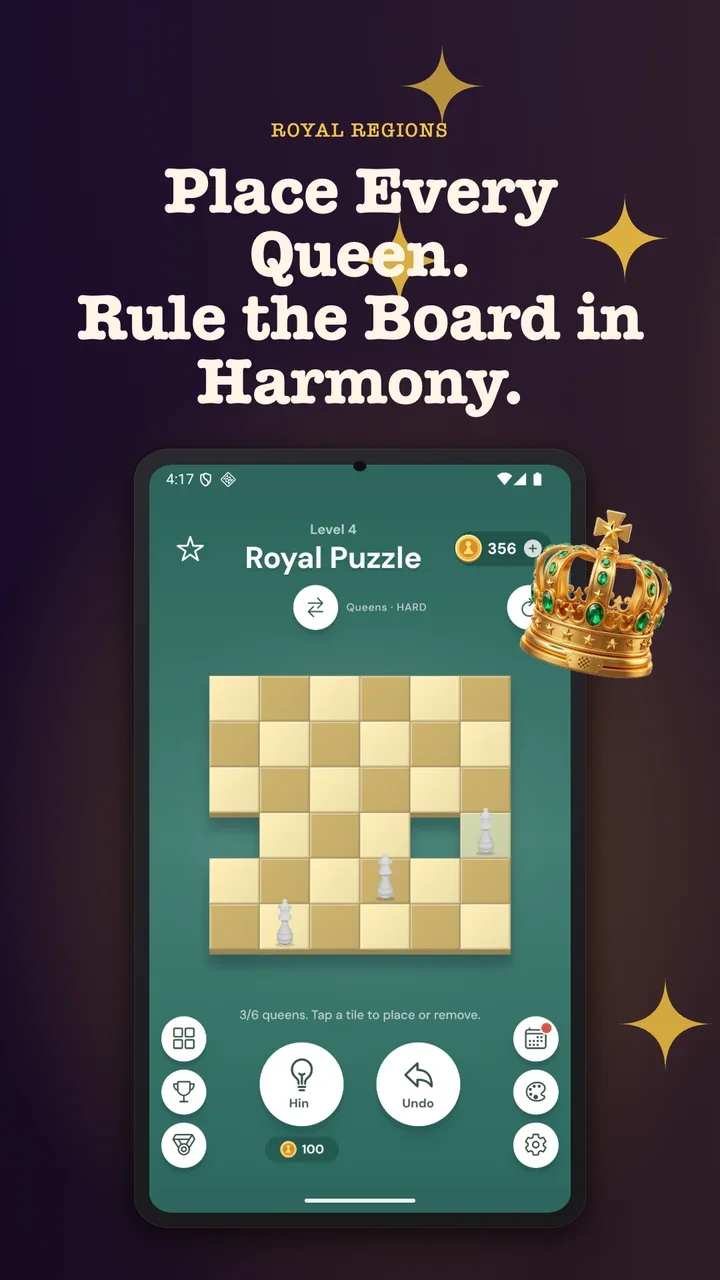 IN-GAME VIEW
Read the colored regions together with the placement rules displayed by the game. Keep candidates separate from confirmed placements.
Gameplay reference, not a solution to a specific level.Look for a requirement with nowhere to go
After trying a candidate placement, inspect every unfinished region. Does each still contain at least one legal square? Repeat that question for any row or column that must contain a queen. A zero-candidate requirement is a clear stopping point for the branch.
A second pattern is two requirements competing for one available space. If two different regions can each place a queen only in the same row, and the level permits just one queen in that row, they cannot both be satisfied under your current assumption. You can reject the assumption without calculating every remaining square.
Undo the assumption, keep the lesson
Return to the last decision you were not certain about. Reject that candidate and reapply the valid deductions from the original board. If the region now has a single remaining candidate, that placement is justified by the failed branch. The value of the contradiction is that it changes what you know.
Once the board is filled, run a fresh audit rather than relying on the order in which you placed pieces. Check each rule directly against the completed arrangement. This catches accidental placements and mistaken assumptions alike. In Queen Chess, a careful contradiction is more useful than a lucky guess: it explains why one option fails and why the surviving arrangement deserves confidence.
Quick answers
What counts as a contradiction in a placement puzzle?
A concrete violation of a required rule, such as a region with no legal square left or required queens forced into a forbidden conflict.
Should I keep eliminations from a failed guess?
Only those justified independently of the failed assumption. Restore candidates that were removed solely because of that branch.
Try it in Queen Chess.
Place your queens with care. Solve colourful logic boards where no two queens can stand in each other’s way.

 Coming soon