
When a Solo Chess puzzle stalls, choose a plausible final capture and work backward. Identify which piece must survive, where it must stand, and which earlier move can create that position.
Make the ending small enough to understand
A crowded board creates many possible moves, but the ending always has the same size: two pieces immediately before the last capture. Start by imagining that pair. A rook needs its final target on the same clear row or column. A bishop needs a clear diagonal. A knight needs an L-shaped jump. These geometric requirements narrow the possible endings.
Do not commit to a favorite surviving piece just because it looks powerful. Instead, compare a few endings. A survivor that can reach many squares may be flexible, but a less mobile piece might already be positioned for the only workable final capture.
Ask what could create the final position
Suppose you want a rook to make the last capture along a file. The earlier sequence must leave that file clear and place the target somewhere on it. Any plan that leaves the target off the file fails your chosen ending, even if all the preceding moves are legal. This gives you a concrete condition to test.
Work one step back: which piece can capture onto the desired target square? Which piece must remain untouched until then? You are building requirements, rather than trying random captures. If the requirements contradict the starting board, discard that ending and test another.
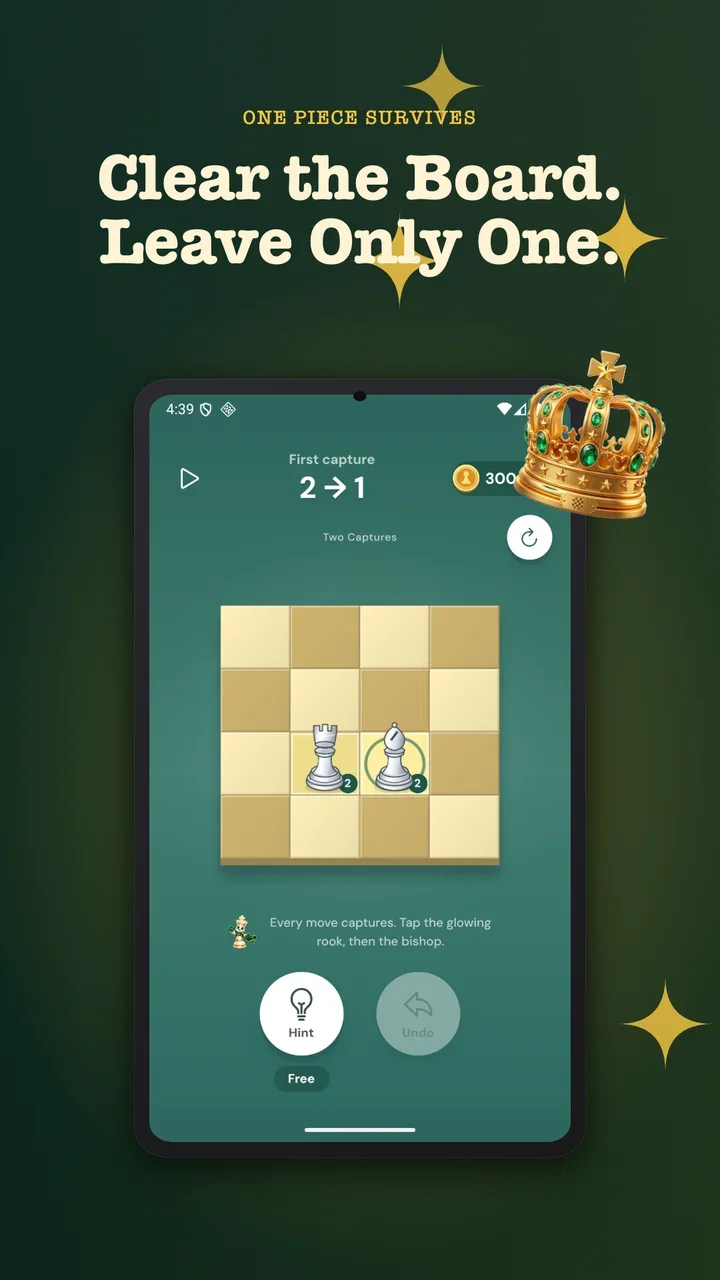 IN-GAME VIEW
Look at the whole board before committing to the first capture. Each move changes the connections that remain.
Gameplay reference, not a solution to a specific level.Treat isolated pieces as warning lights
A piece can become isolated because the piece that could reach it was captured, because the board’s geometry changed, or because a capture limit was used up. Check these possibilities before assuming you have missed an obvious move. Ask which remaining piece could ever reach the isolated square, not only which one can reach it immediately.
There is a useful distinction between temporarily unavailable and permanently stranded. A blocked rook line may open after another capture. A bishop cannot change the color of the squares it travels on, so some apparent connections will never become available through diagonal movement alone. Use those movement facts to reject impossible endings early.
Compare branches with one changed decision
When testing alternatives, change one early decision at a time. If you change the first three moves together, it becomes difficult to learn which choice caused the dead end. Mentally label a branch by its first capture and the intended survivor. That is enough structure for a short puzzle without turning it into paperwork.
Before playing your candidate sequence, check capture allowances displayed on the pieces and count the remaining pieces after each move. Then verify that the final pair has an actual legal capture between them. Working backward does not replace forward checking; it tells you which forward sequences deserve your attention. Use Solo Chess to practice that loop: choose an ending, test its prerequisites, and confirm the whole chain.
Quick answers
Should I always choose the strongest piece as the survivor?
No. Familiar chess values do not decide a capture-order puzzle. Movement, destination squares, and level restrictions determine which survivor works.
Is backward reasoning enough on its own?
No. It narrows the possibilities, but you still need to verify every capture in forward order against the current board and its restrictions.
Try it in Solo Chess.
Every move is a capture. Think a few steps ahead, clear the board, and leave just one piece standing.

 Coming soon