
A short detour can be costly if it leaves Locke without a safe exit. Compare complete routes through the required pickups, including repeated crossings and the final escape, rather than pickup distance alone.
Local progress is not the same as a finished route
Moving closer to a diamond feels like progress, but distance to one pickup says little about the rest of the vault. A route may reach the first cache quickly and then require a difficult return through the same security area. Another route may look longer initially while keeping the remaining pickups and exit connected.
This is the greedy-route trap: choosing the best-looking immediate reward without testing its consequences. In Chess Heist, the remedy is to evaluate start, loot, and exit together. Every detour should have a return plan or a useful onward connection.
Find the vault’s bottlenecks
Look for narrow passages or squares that connect two otherwise separated areas. These are bottlenecks in your route. If several pickups require crossing the same passage, consider whether one loop can serve them together rather than approaching each independently.
Be careful about translating a visual bottleneck into a rule. The actual movement options and security behavior shown by the game decide which passages are usable. A square that appears open may be threatened by a beam; a route that looks indirect may be the only safe connection.
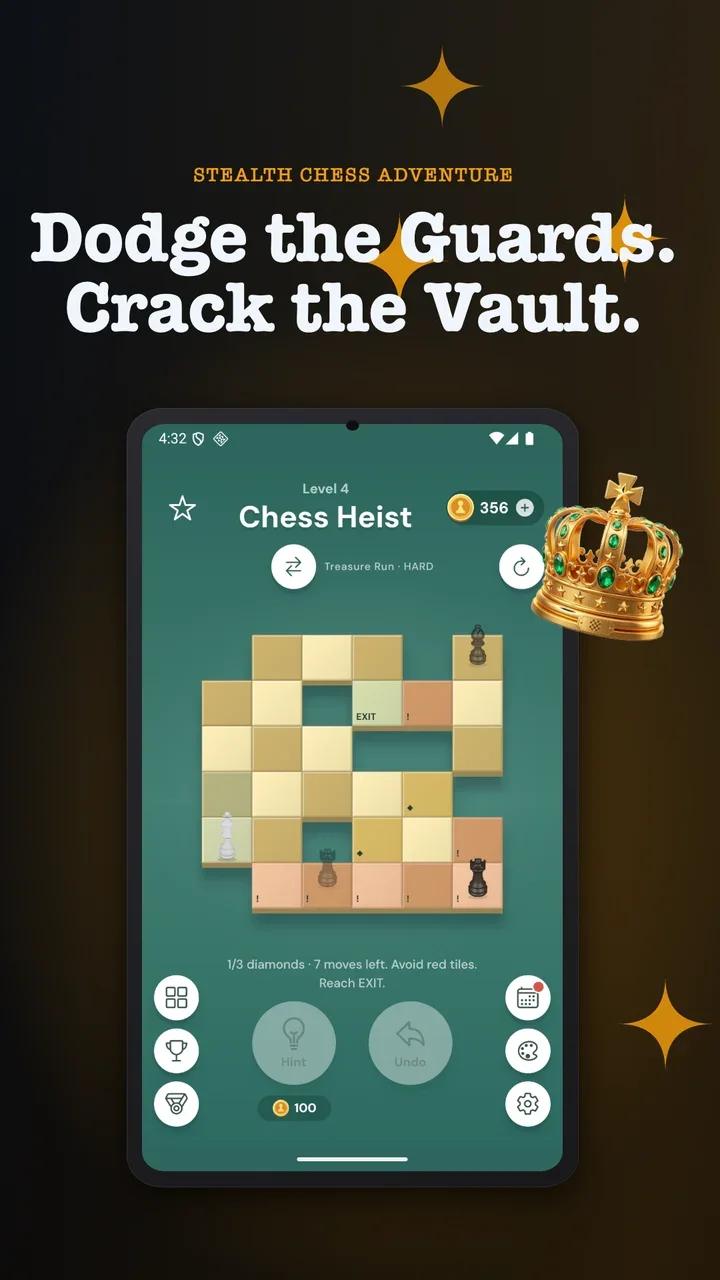 IN-GAME VIEW
Study the security beams, pickups and exit together. Check the route away from a cache before moving toward it.
Gameplay reference, not a solution to a specific level.Compare two complete pickup orders
Choose two plausible orders for visiting the required caches. For each order, trace the approach, the pickup, the departure, and the next connection. Count risky transitions as well as movement. A plan with fewer moves is not useful if one transition has no legal safe continuation.
If you cannot verify the whole route yet, compare the uncertain parts explicitly. One order may have a clear exit approach but an awkward middle segment. Another may make the first pickup easy while leaving the finish unresolved. Prefer investigating the unresolved segment before spending an attempt on a route you already know only halfway.
Keep the final escape visible
After each pickup, recheck the exit route using the current board and security indicators. Do not assume that a route you imagined at the start remains valid without verification. The level’s actual state should guide the next move.
When a run fails, describe the cause as a route condition: no safe departure from a cache, a repeated beam crossing, or an overlooked final approach. That description suggests a specific alternative order to test. Chess Heist’s appeal is the interaction between loot and escape; the strongest plan makes them support each other. Resist the isolated reward, preserve a safe connection, and judge success by the completed heist rather than the first diamond reached.
Quick answers
Does the route with the fewest moves always win?
No. Every step must satisfy the level’s movement and security rules, and the route must collect the required loot and reach the exit.
What should I inspect after a failed heist?
Identify the exact failed segment: the approach, the pickup, the departure, or the final escape. Change that part of the route and verify the rest again.
Try it in Chess Heist.
Dodge the security lasers, collect the diamonds, and find your way out. A sneaky new side of chess.

 Coming soon