
Plan a Chess Heist route from safe stopping point to safe stopping point. Check the security beams, the required diamond pickups, and the route to the exit before making a tempting detour.
Make the exit part of the opening plan
A diamond is a visible reward, so it naturally attracts attention. The exit is the constraint that makes the reward useful. Before moving Locke toward the nearest cache, locate the exit and identify at least one plausible route that connects your starting area to it.
Chess Heist replaces a conventional match with a vault to navigate. Treat the board as a route problem. You are not trying to win a material exchange; you are trying to collect the required loot and finish safely under the level’s rules.
Read beams as boundaries, not decoration
Inspect the security beams and the squares they threaten. If the level changes their state as play proceeds, follow the displayed timing rather than assuming the first view describes the whole attempt. Distinguish an actually safe landing square from a square that merely looks close to safety.
Then identify safe stopping points. These are positions from which you can reassess the next part of the route without having already committed to a dangerous pickup. A route made of a few verified segments is easier to reason about than a long chain of hopeful moves.
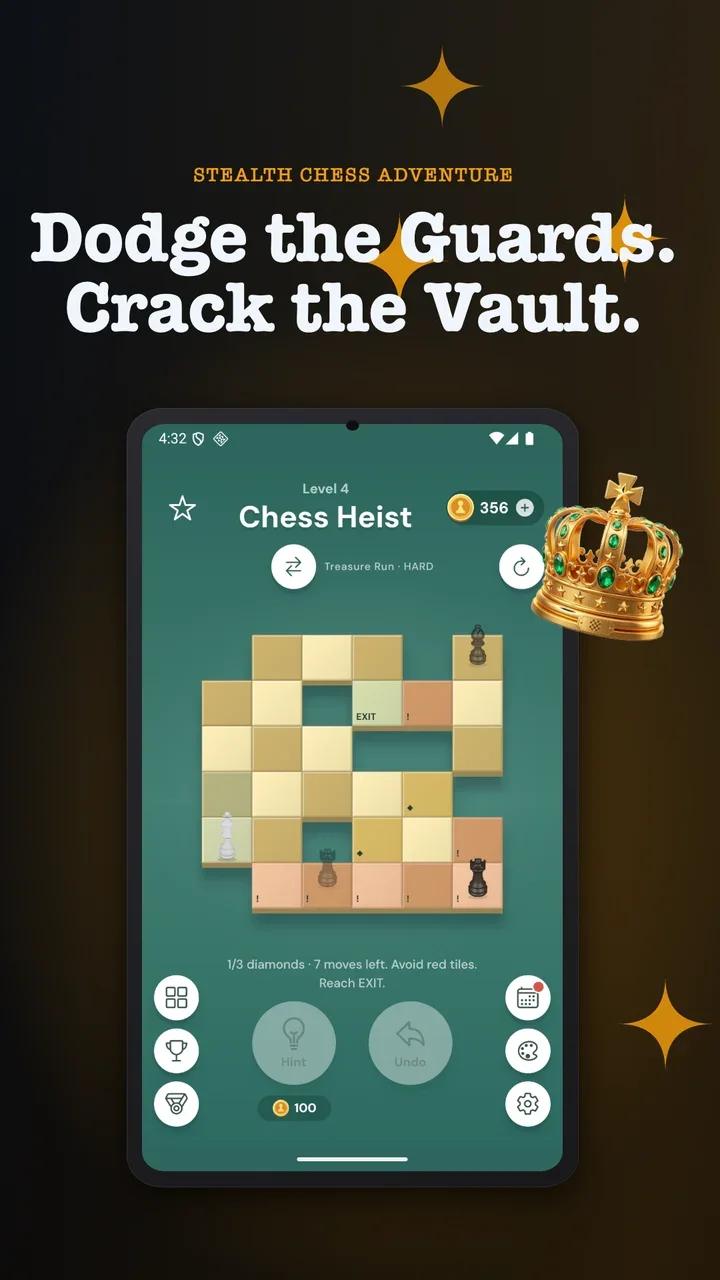 IN-GAME VIEW
Study the security beams, pickups and exit together. Check the route away from a cache before moving toward it.
Gameplay reference, not a solution to a specific level.Connect pickups to the escape route
For each diamond cache, ask two questions: how do I reach it, and how do I leave it? A pickup in a corner or narrow corridor may have only one practical approach. If you enter through that approach, check whether the same route remains usable afterward.
Compare pickup orders. Visiting cache A before cache B may keep the route connected, while reversing them may force a hazardous crossing or a longer detour. The nearest cache is not automatically the best first destination. Inspect the full route cost, including the trip to the exit.
Change one route segment after a failed attempt
If a plan fails near the end, resist changing the entire opening without examining the failure. Was the pickup square unsafe? Did you overlook the exit approach? Did the level’s security state change? Name the problem, then replace the route segment that caused it.
Use the board’s own movement and security indicators to confirm each step. This guide is a planning method, not a universal solution to every vault. The next time you open Chess Heist, spend a moment tracing start, pickups, and exit as one connected journey. That small pause often reveals the difference between collecting a diamond and completing the heist.
Quick answers
Should I always collect the nearest diamond first?
No. Check whether you can leave that pickup safely and still reach the other required caches and the exit.
Is Chess Heist a standard chess match?
No. It is a chess-inspired stealth and route-planning game involving security beams, diamond collection, and an escape objective.
Try it in Chess Heist.
Dodge the security lasers, collect the diamonds, and find your way out. A sneaky new side of chess.

 Coming soon