
Use numbered checkpoints as route constraints rather than isolated targets. Plan how to enter and leave each one while preserving a connected path through all unvisited tiles.
Reaching the number is only half the job
A checkpoint gives your route direction, but arriving there with no usable exit can end the puzzle. Before jumping toward a numbered tile, look at how the knight will leave it. The route must satisfy the checkpoints and still visit every tile once.
Read the level’s checkpoint requirements before calculating. The numbers are constraints supplied by the game; do not replace them with an invented shortest-path objective. A route that reaches the next checkpoint quickly may skip tiles that become unreachable later.
Plan small segments, then connect them
Split the board mentally into the route before a checkpoint, the checkpoint square itself, and the route after it. You do not need to solve all three completely at once. Instead, reserve plausible entry and exit connections so that one segment does not consume the other’s only path.
For example, if an upcoming checkpoint has just two unvisited neighboring destinations in the knight-move graph, using one prematurely may force the other as the entry. That can be helpful information, but only if the remaining path can actually reach it. Track those requirements as you compare candidate jumps.
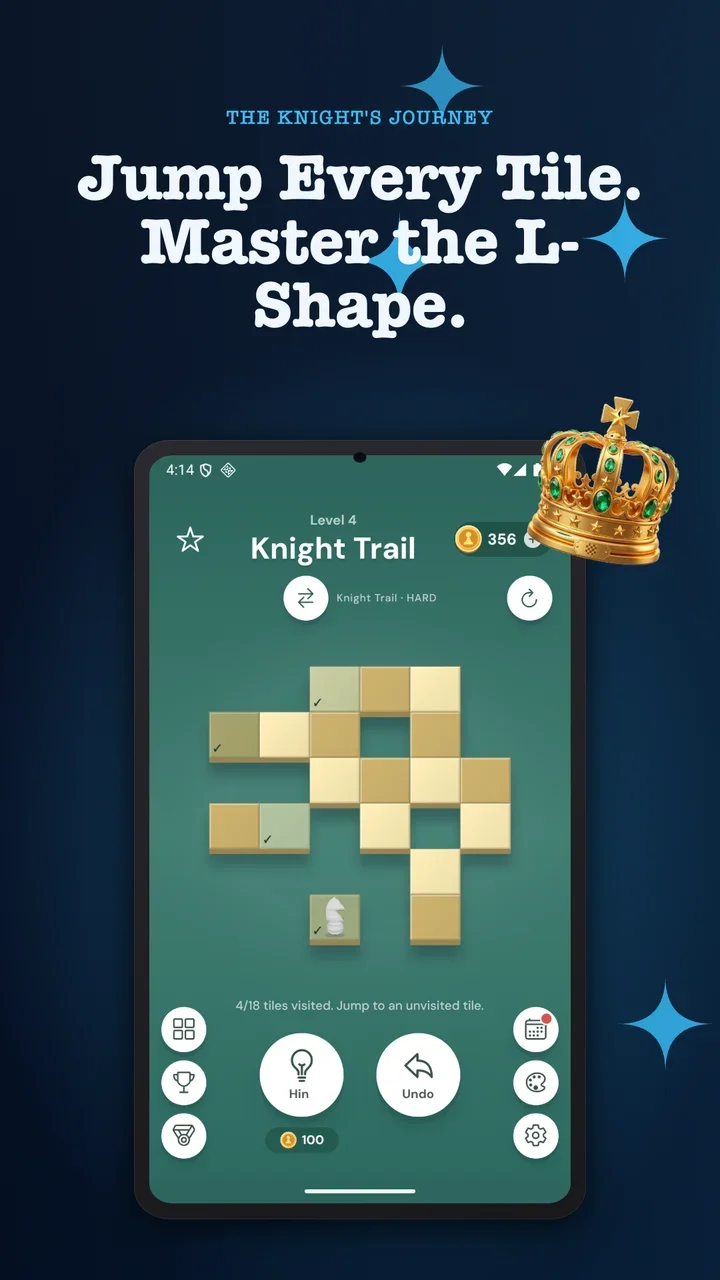 IN-GAME VIEW
Inspect the numbered checkpoints and protect access to the remaining squares. A legal jump is only one part of a complete tour.
Gameplay reference, not a solution to a specific level.Use color as a quick sanity check
On an ordinary checkerboard coloring, every knight move changes square color. After an even number of jumps, the knight is on the same color it started from; after an odd number, it is on the other color. This is a geometric property of the L-shaped move, not a special power-up or level rule.
If a checkpoint requirement specifies an exact move count, that color pattern can reject impossible timing immediately. If it only specifies order, color alone does not determine how many jumps to use. In either case, it is a useful check on a proposed route rather than a complete solving method.
Preserve room for the final stretch
Late in a tour, a route may divide the unvisited tiles into separate islands. A knight can jump over occupied or visited tiles, but it still needs legal unvisited landing squares. Visual gaps on the board are less important than gaps in that landing-square network.
Before each checkpoint transition, scan the leftover tiles and ask whether they remain connected by legal knight jumps. Protect a route into the corners and narrow areas, then verify your finish. Knight Chess becomes more manageable when checkpoints organize your reasoning without distracting you from the whole board. Treat each number as a doorway with an entrance and an exit, and the route between them becomes the real puzzle.
Quick answers
Does a knight change square color on every move?
Yes, on standard checkerboard coloring. A two-by-one jump always changes the color of the landing square.
Should I take the shortest route to each checkpoint?
Not automatically. The full objective includes visiting every tile once, so a short local route can leave required tiles unreachable.
Try it in Knight Chess.
One knight. A board full of possibilities. Hop in L-shapes, visit every tile, and make every jump count.

 Coming soon
For standard piece movement and checkmate definitions: FIDE Laws of Chess, Articles 1–3. Follow each app’s displayed rules for its puzzle-specific objectives.