
In a knight’s tour puzzle, count each reachable square’s remaining exits. Squares with fewer exits often need attention early, but verify checkpoints and the entire remaining route before choosing.
Think of the board as connections
A knight moves two squares along one axis and one along the other. For route planning, physical closeness is misleading: an adjacent square may take several jumps to reach, while a distant-looking square may be one legal move away. Think in connections rather than walking distance.
Knight Chess asks you to visit every tile once while connecting numbered checkpoints. Each visited tile disappears from your future options. A move therefore changes both your location and the shape of the route that remains.
Count the exits you will actually have
For each possible next square, count the unvisited squares the knight could reach afterward. A square near an edge often has fewer choices than one in the middle. A corner of a full rectangular chessboard has only two geometric knight destinations, and previously visited tiles can reduce that number further.
Choosing a low-exit square first is related to a well-known knight’s tour heuristic. Treat it as a guide, not a proof. Board shape, checkpoint order, and the remaining visited pattern can make an apparently sensible low-exit move fail. Look one or two jumps beyond the count before committing.
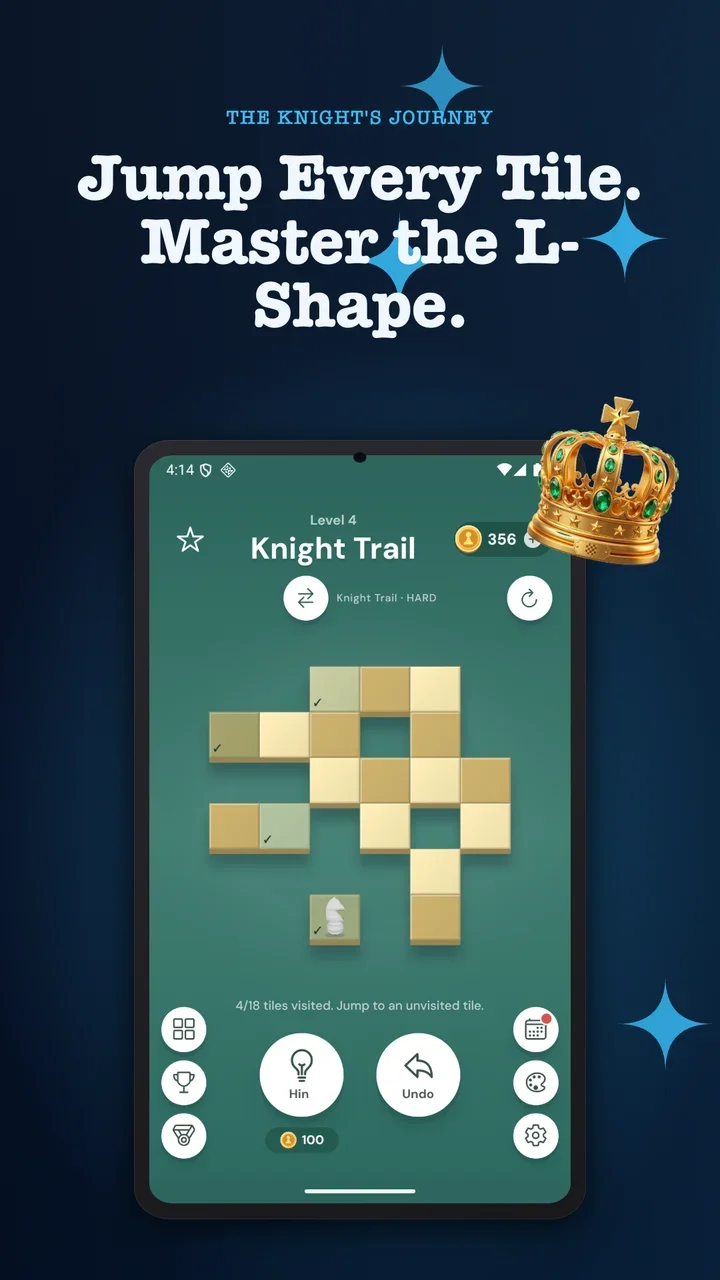 IN-GAME VIEW
Inspect the numbered checkpoints and protect access to the remaining squares. A legal jump is only one part of a complete tour.
Gameplay reference, not a solution to a specific level.Keep awkward squares reachable
Before leaving an area, identify the unvisited tiles with only one remaining route in or out. If you use their last connector for something else, they may become permanently stranded. This is the knight-route version of closing a door behind you without checking who is still inside.
Pay particular attention to tiles that can only be approached through a checkpoint or a narrow section of the board. The danger may not be the square you land on now; it may be the square that loses its last usable connection because of your move.
Recalculate after every jump
Exit counts are not fixed labels printed on the board. Once you visit a tile, neighboring tiles in the knight-move graph each lose a possible connection. A middle square that began with many options can become the most constrained square late in a route.
A practical routine is to compare two candidate jumps, count their remaining exits, check the next checkpoint, and scan for stranded tiles. If the puzzle forces a restart, find the earlier move that cut the route apart. This gives you a reusable lesson instead of just a memorized sequence. With repeated use, the board starts to look like a network of possibilities, which is exactly the perspective a knight’s tour rewards.
Quick answers
Does choosing the square with the fewest exits always solve a knight’s tour?
No. It is a heuristic, not a guarantee. You must also consider board shape, already visited tiles, and the puzzle’s checkpoint requirements.
Can a knight visit a square twice in Knight Chess?
The tour objective is to visit every tile once. A route that revisits a tile does not meet that objective.
Try it in Knight Chess.
One knight. A board full of possibilities. Hop in L-shapes, visit every tile, and make every jump count.

 Coming soon
For standard piece movement and checkmate definitions: FIDE Laws of Chess, Articles 1–3. Follow each app’s displayed rules for its puzzle-specific objectives.